
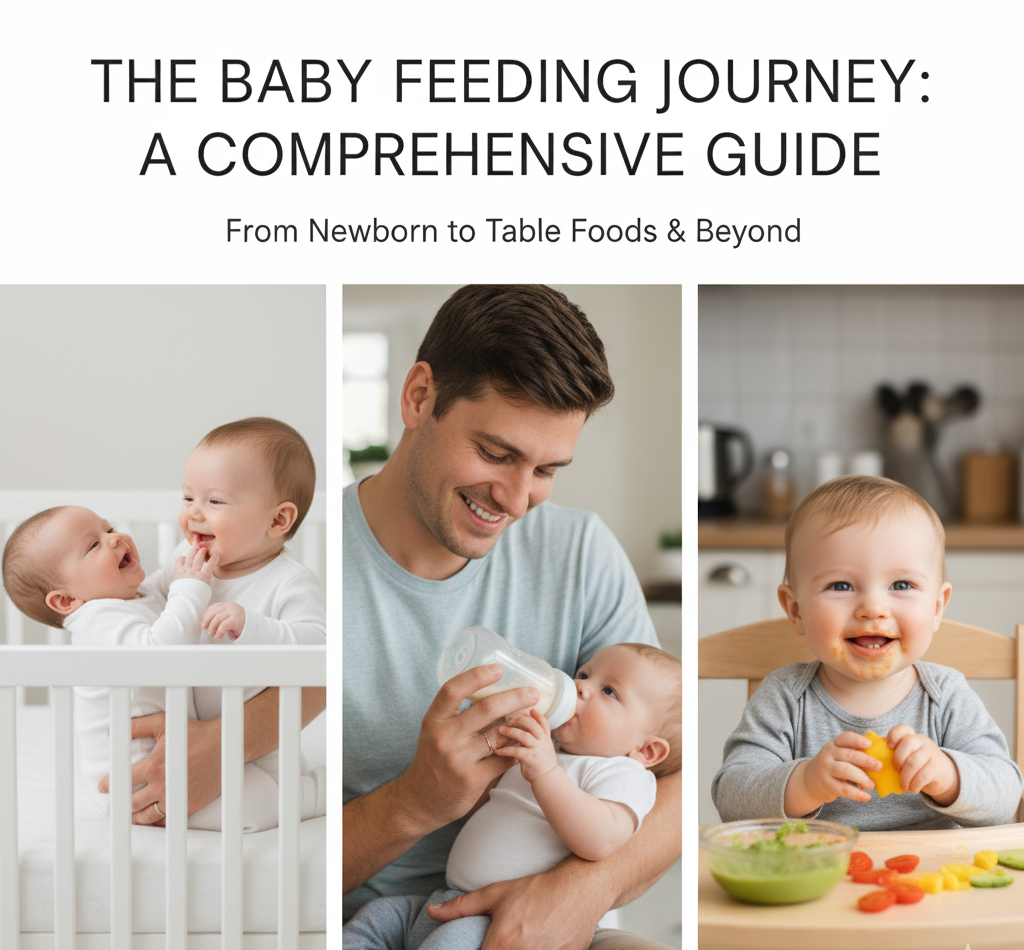
Beyond the Bottle or Breast: An Expert’s Guide to Healthy Baby Feeding Schedules & Solutions
1. The Golden Rule: Feed on Demand (Especially Early On)
Forget the clock! For the first few months, your baby’s tiny tummy needs frequent refills. Responsive feeding, or feeding on demand, is the most crucial principle, regardless of your feeding method.
Learn the Hunger Cues
Crying is the last stage of hunger. Look out for these early and active signs:
-
Early Cues: Stirring, licking lips, opening and closing mouth, turning head (rooting).
-
Active Cues: Sucking on hands or fingers, squirming, fussing.
What to Expect in the Early Weeks (Newborn to 1 Month):
-
Frequency: 8–12 feedings in a 24-hour period (roughly every 2–3 hours).
-
Volume: Small amounts initially, which quickly increase. Breastfed babies tend to eat more frequently than formula-fed babies because breast milk is digested faster.
The Check: If your baby is gaining weight steadily, has at least 6–8 wet diapers, and 2–5 or more bowel movements a day by day five, they are likely getting enough!
2. Breastfeeding vs. Formula: Your Informed Choice
Both options provide excellent nutrition, and the “best” choice is the one that works for you and your family.
🤱 Breastfeeding
Often called the “perfect food,” breast milk offers a unique blend of easily digestible nutrients and antibodies that help protect against infection.
-
Key Tip: Master the Latch. Pain usually indicates a poor latch. Ensure your baby takes a large portion of the areola, not just the nipple. If you struggle, a lactation consultant is an invaluable resource.
-
Stay Hydrated! Nursing mothers should focus on a balanced diet and drink plenty of water to support milk production and their own health.
🍼 Formula Feeding
Infant formula is a healthy alternative that contains all the necessary nutrients your baby needs to thrive.
-
Key Tip: Proper Preparation. Always follow the instructions on the formula container precisely for mixing and storage to ensure your baby gets the correct concentration and avoids contamination.
-
Bottle Pacing: If bottle-feeding (breast milk or formula), practice paced bottle feeding. This mimics the flow of breastfeeding, allowing your baby to better control their intake and reducing the risk of overfeeding.
3. Starting Solids: The Exciting (and Messy) Transition
Around six months of age, your baby is generally ready to begin exploring solid foods. This is a journey of taste and texture exploration, with breast milk or formula remaining their primary source of nutrition until age one.
Signs of Readiness
No matter the feeding style, wait for these key milestones:
-
Can sit up on their own or with very little support.
-
Has good head and neck control.
-
Shows interest in food (e.g., reaching for your plate).
-
Lost the tongue-thrust reflex (they don’t automatically push food out of their mouth).
Purees vs. Baby-Led Weaning (BLW)
You don’t have to choose! Many parents use a combination approach.
| Method | Description | Key Benefit |
| Traditional (Purees) | Spoon-feeding smooth, pureed foods (fruits, vegetables, cereals). | Easy to track intake and ensure nutrient density initially. |
| Baby-Led Weaning (BLW) | Offering soft, appropriately-sized finger foods that the baby self-feeds. | Encourages fine motor skills, independence, and exposure to different textures. |
Safety Note: Whether you use purees or BLW, always supervise your baby closely while they eat. Understand the difference between harmless gagging (which is loud, and helps the baby learn) and silent choking.